The Intentional Father: A Tactical Guide to Initiating Your Son Into Manhood
Based on Jon Tyson's The Intentional Father, with supporting research and a step by step plan.
Start Here
Jon Tyson has pastored for twenty five years and counseled hundreds of men in that time. What struck him was how few of them were free of a father wound. He described it as a ghost in their story that haunts them, and they don't know what to do with it.
These are grown men. Married, working, capable. And still waiting on a word that never came.
When his own son Nate got close to adolescence, Tyson went looking for the book he wanted. Not another reflection from an older, wounded man, but a manual from a dad who had actually run the race and could hand over the map. He couldn't find one, so he made his own. He discipled Nate deliberately, most mornings, from around twelve until he left for college.
His stated goal is the best summary of the whole framework: he wanted to give fathers a plan to become an ancestor, not a ghost.
The Claim
"Self-initiation is killing our young men."
Tyson's argument is that every boy gets initiated into manhood one way or another. The hunger to prove himself is already in him. The only real question is who runs the ceremony.
If a father doesn't lead his son through it, the son will initiate himself, often at real cost, or the culture will handle it. Pornography teaches him what a man wants. Games teach him what a man conquers. The group chat teaches him what a man laughs at. Hustle culture teaches him what a man is worth. None of it will ever tell him he's enough, because a boy who feels enough stops buying things.
Tyson also names the trap that catches decent, well-meaning dads. A thirteen year old is not inspired by a tired, overwhelmed man. Nobody looks up at an exhausted father and thinks, I can't wait to be busy and worn out. Being a guy who doesn't do bad things isn't a vision for a son. It's just a vacancy.
Deal With Your Own Story First
Tyson quotes Richard Rohr: "Whatever pain is not transformed is transmitted." We tend to break our kids in the same place we're broken, because we never found a way through it ourselves.
So the first move isn't a ceremony. It's an honest look at your own initiation, or the lack of one. You can't hand your son a door you've never walked through.
Give it an hour, alone, with the phone off:
What did I need my father to say that he never said?
Where am I still trying to earn something from a man who isn't coming?
What did he get right that I've never thanked him for?
What am I about to pass on instead of resolve?
Tyson wrote a letter to his own father naming what he got right. Worth considering, though not for your dad's sake. Your son is watching how you carry your own ghost.
The Evidence, If You Need It
You probably feel this already. But you'll need something concrete when you recruit other men, or explain it to a skeptical spouse, or drag yourself out of bed on a Tuesday.
The vacuum:
Teens 13 to 18 average about eight and a half hours of screen media a day (8:39), not counting schoolwork. Barna's David Kinnaman puts it bluntly: screens are discipling young people.
In 2023, 39.7% of high schoolers reported persistent sadness or hopelessness, and 28.5% reported poor mental health. In 2021, 14.3% of boys in high school had seriously considered suicide.
Roughly 70% of kids raised in church leave the faith when they go to college.
About 1 in 4 U.S. children, some 17.8 million, live without a father in the home, though resident father presence is actually at a 34 year high, with about 75% of kids living with a father figure. Presence isn't the shortage. Intention is.
What protects them:
CDC's 2023 analysis found that every protective factor studied, including family support and connectedness, was associated with lower rates of poor mental health and suicide risk.
At-risk students with a mentor were more likely to aspire to college (76% versus 56%) and to actually enroll (45% versus 29%).
Students meeting regularly with a mentor were 52% less likely to skip school.
Of those who had a mentor growing up, 93% said it gave them a sense of belonging, and 93% said it helped them understand who they were.
Even so, one in three young people reaches adulthood without a mentor of any kind.
The older evidence. Arnold van Gennep's The Rites of Passage (1909) found the same three part structure across cultures: separation from childhood, a threshold phase, and reincorporation with new status. Almost every durable culture has done on purpose what we now leave to chance.
And the biology. Adolescent brain research shows sensation seeking and reward sensitivity spike early, while the prefrontal cortex keeps maturing into the mid twenties. Your son's appetite for risk and status shows up years before his judgment does. He's going looking for a proving ground either way.
The Four Stages
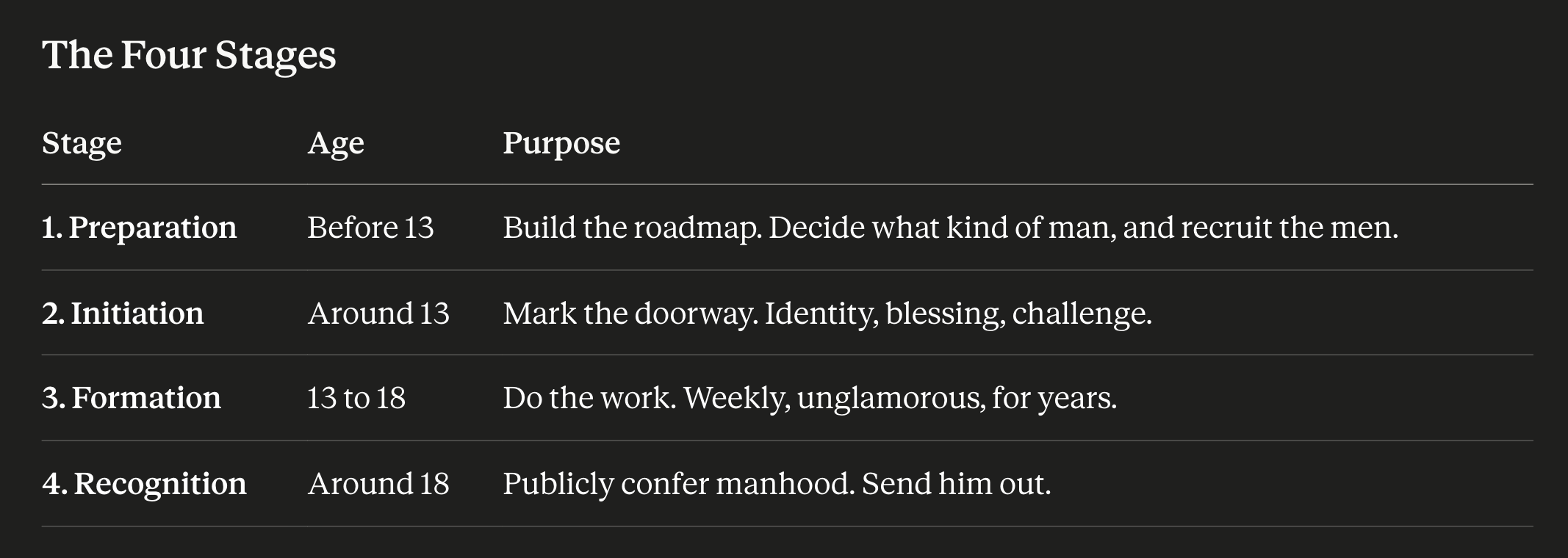
Tyson lands on thirteen because so many cultures have treated it as the start of responsibility, bar mitzvah being the obvious example. But he's clear that the ceremony opens the process rather than completing it.
STAGE 1: PREPARATION (Before Age 13)
Everyone wants to jump to the ceremony. Don't. Without a roadmap behind it, your son will read it as performance, and he'll be right.
Four Questions
Write the answers by hand. This becomes your founding document.
What kind of man do I want my son to become?
What experiences will help shape him?
What skills should he have before he leaves home?
What relationships and mentors should influence him?
Work Backward From Eighteen
Tyson reverse engineered his son's development starting from age 18. Copy it.
Put the date of his 18th birthday at the top of a page.
List the competencies he needs by then. Be concrete. Not "financially responsible" but "runs a bank account, builds a budget, has held a job, gives generously."
Spread them across the years. Two or three a year is plenty.
Give each one an owner: you, your wife, a mentor, a program.
A starter list worth stealing:
Change a tire, jump a car, use basic tools
Cook five meals well
Manage money and a budget
Write a thank you note and a professional email
Hold eye contact, shake a hand
Interview for and keep a job
Handle a confrontation, including how to walk away
Study Scripture without you in the room
Defend what he believes without being obnoxious
Apologize specifically and repair a relationship
Say no to a friend, in person
Serve someone who can't repay him
Recruit the Council
The highest leverage move in the whole system, and the one most dads skip.
Tyson credits Bruce Feiler's The Council of Dads as part of the inspiration. The premise is old and simple: a boy needs more than one man.
Who: four to eight men who already know your son and whose lives you respect. Faithful beats impressive.
What you ask for:
Presence at the initiation
A prepared blessing, a Scripture, and one specific observation about his character
Some ongoing role over the next five years, even if it's one meal a year
A script you can send as is:
"I'm doing something intentional with [son] as he turns 13. Instead of letting adolescence just happen to him, I want to mark it, and I want a few men who actually know him to speak into who he's becoming. Would you be one of them? It means showing up for [date], preparing a short blessing, and staying somewhere in his life over the next five years. He respects you. That's why I'm asking."
A boy can write off "I see you" from his dad as obligation. He can't write it off from six men.
STAGE 2: INITIATION (Around Age 13)
Tyson's own ceremony ran several days with trusted men who knew his son.
The Five Elements
1. The father speaks identity
The most important moment of the weekend. Don't outsource it and don't improvise it. Write it out.
Every boy carries the same unspoken question: am I enough? If no man answers it, he'll spend decades trying to answer it himself through work, women, or money.
Say these out loud, in front of witnesses:
I see you.
I know you.
I am proud of you.
You belong.
I believe in the man God is making you.
Then get specific. Generic praise slides off. Observed character sticks.
Weak: "You're such a good kid."
Strong: "Last spring when Nate got cut and nobody would sit with him, you did. Nobody made you and nobody saw it but me. That's what courage looks like with no crowd around, and I saw it."
The biblical pattern is worth naming here. Jacob blessing his sons, Moses commissioning Joshua, and the Father over Jesus at the Jordan: "You are my beloved Son, with whom I am well pleased." That came before any public ministry. Identity precedes performance, which is essentially the theology of the whole ceremony.
2. Trusted men affirm him
Give the council a structure so nobody wanders. Each man brings:
One strength he's actually seen in your son
One gift he sees in him
One Scripture he's giving him
One piece of wisdom for the road
Try to get more than one generation in the circle. A man in his seventies can say things a man in his thirties can't.
3. Physical challenge
Tyson calls these marking moments. The body remembers what the mind forgets.
Backpacking, a summit, a long hike, cold water, survival skills, some kind of endurance event. Whatever fits your family and your terrain.
The message is one line: you can do hard things.
Not hazing, not punishment. Design it so it's genuinely hard, genuinely safe, and genuinely completable. If he fails it, you've taught him the opposite of what you meant to.
4. Spiritual challenge
Build in solitude. This is where he begins hearing from God directly instead of through you.
A real block of silence, 60 to 90 minutes for a thirteen year old rather than a whole day
A journal and three questions: God, who do you say that I am? What do you want me to know? What do you want me to do?
Then bring him back to the fire and let him share whatever he wants, with no pressure to produce a spiritual experience
You're not chasing a mystical moment. You're establishing that hearing from God is normal, available, and his to do.
Tyson also talks about wanting his son in a liminal space where his heart would break for the poor of the world, so complacency would always haunt him a little. Worth considering whether service belongs in the initiation rather than as a nice extra.
5. Symbolic gifts
What the object represents matters more than the object. Choose things that carry weight.
A Bible with his name and the date in it
A watch, since time is now his to steward
A knife, where it's appropriate and safe
A family heirloom
A written blessing he can reread at twenty five when things fall apart
A family crest or symbol
Do not give a phone as an initiation gift. You'd be handing him the most effective self-initiation device ever built and calling it a rite of passage.
Sample Three Day Run of Show
Friday, separation. Leave. Physically go somewhere, because separation is the first move of any rite of passage. That night: fire, food, and your opening word. Tell him plainly what these days are and why you're doing them.
Saturday, the threshold. Morning is the physical challenge. Afternoon is solitude, alone with the journal and the three questions. Evening is the council, and this is the center of the whole thing. Fire, circle, each man speaks, you go last and longest. Lay hands on him. Pray over him.
Sunday, return. Gifts, charge, covenant. Name what comes next, out loud: every Tuesday, 6:15, you and me, for the next five years. Then go home and tell his mother and siblings what happened. Reincorporation is the third movement, and skipping it hollows out the other two.
STAGE 3: FORMATION (13 to 18)
This is where nearly every father quits, and it's where nearly all the value is.
The ceremony is the doorway. Formation is the house. Tyson met with Nate weekly, often early in the morning before school, for years, and reviewers note he spent something like forty five minutes on devotions most mornings.
You may not have a flexible job and a five minute commute. Scale it to your life. But the math still holds: a weekly hour for five years is roughly 250 mornings, and that's the actual program.
The Weekly Meeting
Same day, same time, on the calendar, defended like a client meeting. Outside the house if you can manage it. Phones off, yours included. An hour is plenty.
A format you can repeat without thinking:
Check in, 10 minutes. How are you actually doing? What's hard right now?
Content, 25 minutes. One topic.
Scripture, 15 minutes. Read a passage and ask what he notices, not what he's supposed to notice.
Charge, 10 minutes. One thing to practice this week. Write it down and ask about it next week.
Three Domains
Character: integrity, courage, humility, purity, perseverance.
Theology: knowing God rather than knowing about him, biblical worldview, Scripture literacy, apologetics, holding a belief under pressure.
Practical manhood: finances, work ethic, leadership, conflict resolution, service, decision making, emotional maturity, relationships and how to treat women, vocation.
Tyson's line here is the sharpest in the book: it isn't enough to raise sons who are good men, we need them to be good at being men.
And the model isn't a vague ideal of masculinity. It's Jesus, who knew when to get angry and when to weep, when to fight and when to engage, when to answer and when to ask a question.
The Five Shifts
Coach each one on purpose. None of them happen on their own.
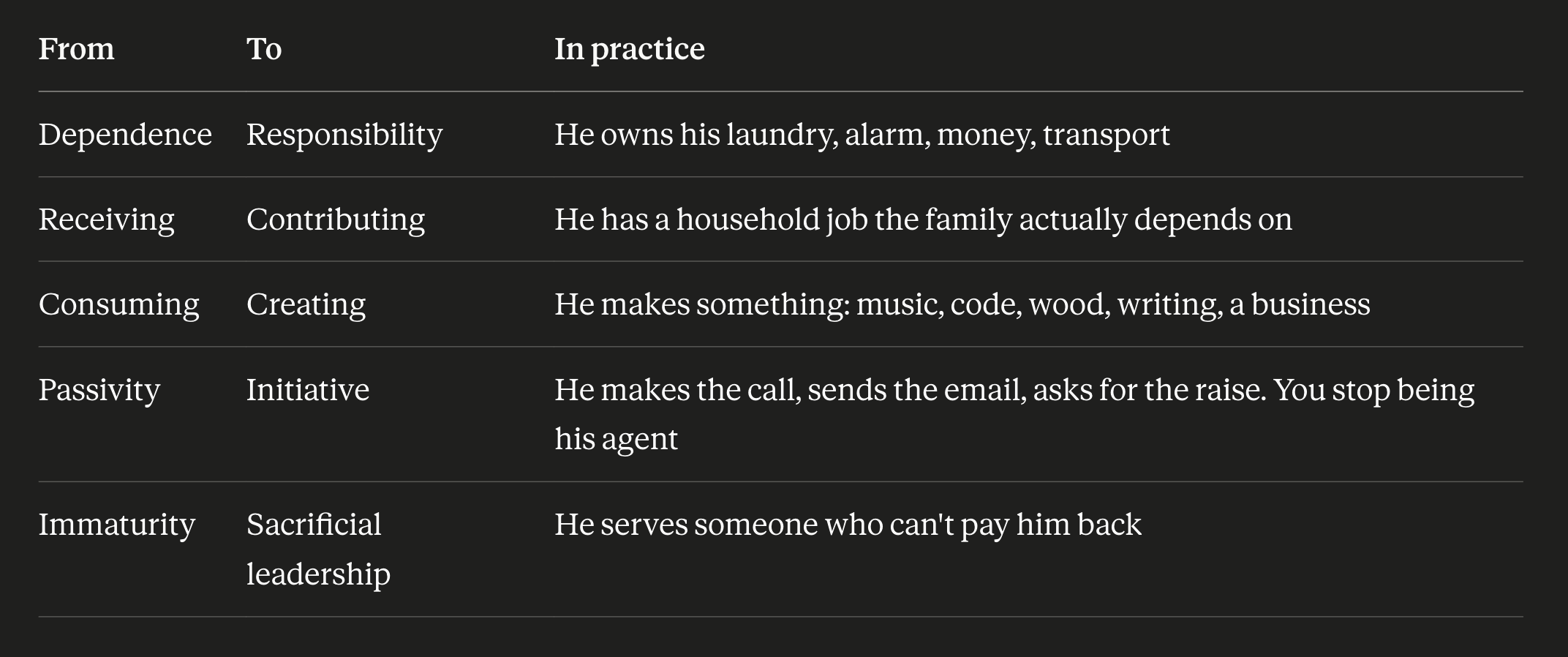
From To In practice Dependence Responsibility He owns his laundry, alarm, money, transport Receiving Contributing He has a household job the family actually depends on Consuming Creating He makes something: music, code, wood, writing, a business Passivity Initiative He makes the call, sends the email, asks for the raise. You stop being his agent Immaturity Sacrificial leadership He serves someone who can't pay him back
A Five Year Skeleton
13, identity. Who are you, who is God, and how do you sit in silence.
14, purity and the body. Sex, pornography, appetite, honor, discipline. The real conversation, not the euphemism.
15, work. First job, money, time, excellence, showing up when you don't feel like it.
16, relationships. Conflict, forgiveness, friendship, trustworthiness, how to treat women.
17, calling and launch. Vocation, gifts, decisions, finances, leaving well.
Tyson is adamant about not outsourcing your kid's discipleship to the youth group. The youth pastor is a supplement. You're the source.
STAGE 4: RECOGNITION (Around 18)
The journey closes with a second ceremony, and it isn't a graduation party. Graduation celebrates what he finished. This celebrates who he's become.
Bring back the same men if you can. Honor his character by name, with actual evidence. Pray a commissioning over him. Celebrate as a family. Formally hand him adult responsibility.
Tyson points to Luke 24:50, where Jesus lifts his hands and blesses the disciples as he sends them out. The sending and the blessing belong together.
Then somebody has to say the words: you are now recognized as a man. If nobody ever says it, he'll keep auditioning for it the rest of his life.
Adapting This
Your son is already 15 or 16. Start anyway, compressed. Skip the pretense that you're on schedule and tell him the truth: I should have done this earlier, I'm doing it now. That confession does its own work. Late intention beats none.
You're a single mom. The council carries the load. Uncles, coaches, pastors, neighbors. The mentoring research is strongest precisely where a resident father is missing. You can convene all of this even if you can't personally give the father's blessing, and you can still speak identity over him yourself.
Things are strained between you. Don't open with a ceremony. Open with consistency. Show up weekly for six months with no lecture and no agenda, and earn the right to bless him. A ceremony without relational credibility reads as manipulation, and he'll know.
You have daughters. The four stages transfer. The content doesn't. Tyson built a separate path for his daughter around key deposits a father makes in her life. Identity, blessing, challenge, formation, and recognition are human needs, not male ones, so write your own rather than swapping pronouns.
You want company. Run it as a cohort. Four to six families with sons of similar age, a shared initiation weekend, fathers meeting monthly to stay honest about the weekly meetings. The men keep each other from quitting, and that's the difference between finishing and not.
Five Ways This Fails
Ceremony without formation. You gave him a mountaintop and then left him in the valley. Worse than doing nothing, because now he has evidence his father starts things and doesn't finish them.
Generalities. "You're a great kid" doesn't answer am I enough. Specific, observed character does.
Making it about your regret. This isn't therapy for the initiation you never got. Handle your ghost somewhere else, with God and with other men.
Demanding a response. He may be awkward or completely flat. Bless him anyway. The seed doesn't have to sprout in front of you.
Quitting the weekly meeting in month four. That's the real test, not the mountain.
Your First 30 Days
[ ] Week 1: Write your own inventory. Then answer the four preparation questions. One hour, alone, phone off.
[ ] Week 2: Build the backward map from his 18th birthday. List competencies, assign owners.
[ ] Week 3: Recruit the council. Ask six or eight men and expect a few no's.
[ ] Week 4: Put the weekly meeting on the calendar and start it now, before any ceremony. Then pick the initiation date and book it.
You won't feel qualified. Nobody does. Ancestor or ghost.
Sources
Jon Tyson, The Intentional Father: A Practical Guide to Raise Sons of Courage and Character (Baker Books, 2021), plus the Primal Path course
Bruce Feiler, The Council of Dads, referenced by Tyson
Arnold van Gennep, The Rites of Passage (1909)
Rideout, V. et al., The Common Sense Census: Media Use by Tweens and Teens (Common Sense Media, 2021)
CDC, Mental Health and Suicide Risk Among High School Students and Protective Factors, YRBS 2023 (MMWR)
Bruce, M. and Bridgeland, J., The Mentoring Effect (Civic Enterprises and Hart Research for MENTOR, 2014)
Garringer, M. and Benning, C., Who Mentored You? (MENTOR, 2023)
U.S. Census Bureau data via the National Fatherhood Initiative
Laurence Steinberg, Age of Opportunity
Barna Group research on fatherhood with Tyson and David Kinnaman